



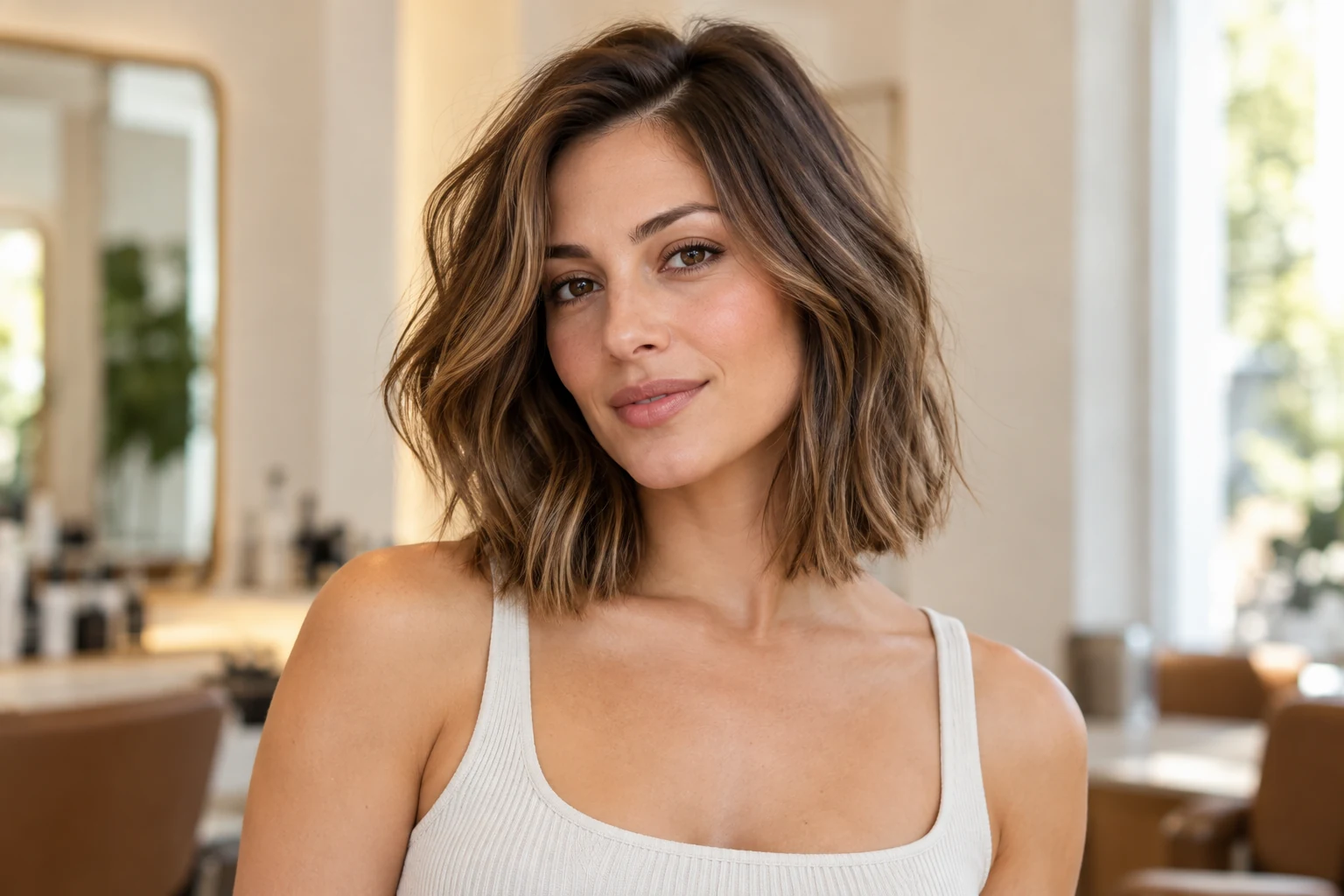
The main difference between a bob and a lob is length: a lob is a longer version of a bob. A bob often sits around the jaw or above the shoulders; a lob usually sits closer to the shoulders or collarbone. Salon naming varies, so agree on a dry length landmark instead of relying on the label.
The useful question is not which name is better. It is which length supports the things you do with your hair each day: wearing it loose, tucking it back, keeping it off your neck or putting it into a ponytail.

Compare the everyday decisions
| Decision | Shorter bob | Longer bob or lob |
|---|---|---|
| Visible outline | Length sits closer to the face and neck | More length extends below the jaw |
| Shoulder contact | May clear the shoulders | May rest against clothing or shoulders |
| Tying back | Front or nape pieces may stay out | More length may reach, but layers still matter |
| Styling access | Short back sections can be harder to reach | More working length for brushes or clips |
| Upkeep priority | Preserving a precise short outline | Managing the outline as it reaches the shoulders |
These are planning tradeoffs, not guarantees. Head size, the starting cut, curl shrinkage and the length of the shortest sections affect every row.
Length and layering are separate choices
Both a bob and a lob can have a blunt-looking outline, layers, a fringe or an angled front. “Lob” does not automatically mean layered, and “bob” does not automatically mean one uniform line. L’Oréal Paris’s lob guide includes several structures, illustrating why the length name alone is incomplete.
At the appointment, describe the outside edge first. Then ask what internal layers, if any, are needed for the finish you want. If your main priority is a dense-looking perimeter, explain that before requesting movement everywhere.
Test your tie-back requirement
Tell the stylist exactly what you need: a full low ponytail, a small half-up style, or just the front out of your eyes. Those are different length requirements. Ask the stylist to show which current pieces would stop reaching after the cut.
Do not assume “shoulder length” guarantees a ponytail. Short face-framing layers may still fall out. Conversely, a shorter perimeter may be fine if you only use two clips at the front.
Consider your normal texture and part
Choose references that show a comparable finish. If you air-dry waves, a flat-ironed photo tells you little about the shape you will see most mornings. If you wear curls, discuss the finished dry outline and how much it changes when stretched.
Show your normal part before the length is agreed. Moving a side part can change where the front falls. Also mention habits that reshape the silhouette, such as tucking one side behind the ear or wearing a high collar.
Ask about the work between appointments
A shorter cut is not automatically a faster routine. It removes some length but may expose a nape area you want kept tidy. A lob retains more length, but the ends may need attention when they begin meeting the shoulders.
Ask for the simplest finish on your own hair. Can you arrange it with your hands? Does it need a deliberate end bend? Will the shortest pieces need separate styling? Request the routine before choosing based on the word “easy.”
A consultation brief you can adapt
“I am deciding between a bob and a lob. I want the dry edge at [landmark] and need [specific tie-back requirement]. I normally wear [texture and part]. I want to keep [full ends/movement/a clear angle], and I can spend [your realistic time] on styling. Please show the front, side and back length before cutting.”
If you are moving from much longer hair, compare the tradeoffs in our long haircut guide. Our haircut ideas for mature women offers more silhouettes; age does not require either length.
Common questions
Which one suits a round face?
Either can be adapted. Talk about where you want width or length in the silhouette instead of treating face shape as a ban on one cut.
Which one is better for fine hair?
The perimeter, layering and starting density matter alongside length. Ask what needs to stay at the edge to create the appearance you want.
Can I start longer and go shorter later?
Yes. Ask for a staged decision if you are uncertain, while remembering that removing existing layers is a separate grow-out question.




Leave a comment